How to Verify a Fractional Real Estate Platform Before Investing in Dubai
Investing in fractional real estate in Dubai? Learn 11 practical checks to verify a platform, its legal structure, fees, property documents and exit terms.
Before investing in Dubai real estate, there is one question worth asking before you compare rental yields, projected returns, or property prices:
Can you independently verify what you are investing in, who is responsible for it, and what rights you will have as an investor?
Fractional real estate in Dubai can offer an alternative to purchasing an entire property independently. Depending on the structure, investors may participate through shares in a company, a special purpose vehicle (SPV), a registered property interest, or another legally documented arrangement.
But a lower entry amount does not automatically mean lower risk. Nor does an attractive property, a polished website, or a professional presentation establish that an investment opportunity is suitable for you.
For business owners, senior professionals, high-income earners, NRIs, and globally minded investors exploring Dubai residential real estate investment, the priority is to understand the investment before committing capital.
This guide explains how to verify a fractional real estate platform in Dubai through 11 practical checks, helping you ask better questions and identify the documents you should review before making a decision.
Why due diligence matters in fractional real estate
When purchasing an entire property directly, you generally deal with the property transaction, ownership documentation, ongoing costs, and eventual sale yourself.
In a fractional investment, additional parties and arrangements may be involved. A platform may introduce the opportunity, an SPV may hold the property, a property manager may oversee the rental, and contractual agreements may define how investors receive income or participate in decisions.
Your rights depend on the actual legal structure—not simply on what the platform calls the investment.
That is why due diligence should cover three connected areas:
A credible investment process should allow prospective investors to understand these matters through appropriate documentation and independently verifiable information.
Part 1: Verify the platform
1. Establish the company's legal identity
Start by distinguishing the brand you see online from the legal entity responsible for the investment.
Request:
If several entities are involved, ask what each one does and which entity you will contract with.
Verify available registration information through the relevant official registry. Where the company operates through a UAE mainland or free-zone entity, check the appropriate licensing authority.
Why this matters: The company marketing an opportunity, the entity signing your agreement, the entity receiving funds, and the entity holding the property may not be the same.
Understand the relationship between them before proceeding.
2. Understand the applicable regulatory framework
One of the most important due-diligence questions is whether the activities involved in the particular offering are appropriately licensed, registered, or authorised where required.
There is no single regulatory answer that applies to every fractional real estate arrangement.
Depending on the structure and activities involved, relevant authorities may include the Dubai Land Department (DLD), the Real Estate Regulatory Agency (RERA), or an applicable financial-services regulator.
Ask the platform:
Then check the answer through the relevant authority's official channels.
Do not assume that a company's trade licence automatically authorises every investment-related activity it may undertake. Equally, do not assume that every fractional structure requires the same type of financial-regulatory approval.
The objective is to establish what applies to the actual offering—not to rely on a general claim that a platform is regulated.
3. Identify the people and organisations responsible
Investors should understand who is accountable for the important functions of an investment.
Depending on the arrangement, these may include property acquisition, asset management, rental operations, investor administration, accounting, and decisions concerning the eventual sale.
Ask who performs each function, whether the responsibilities are documented, and whether external service providers or related companies are involved.
Where relevant, review the experience and professional background of the people responsible. Distinguish independently verifiable experience from promotional biographies and marketing claims.
If responsibilities are divided across multiple organisations, establish how they work together and who investors should contact when a question or dispute arises.
Part 2: Verify what you are investing in
4. Establish exactly what you will legally own
This is arguably the most important question in fractional real estate:
What legal interest will you acquire in exchange for your investment?
Depending on the offering, the answer could involve shares in an SPV that owns a property, a registered co-ownership interest, units in a fund, or another legally defined interest.
These structures can create different rights, obligations, restrictions, and remedies.
Before investing, request the relevant agreements and establish:
Do not rely solely on an app dashboard, a booking confirmation, a certificate with unclear legal effect, or a verbal explanation.
You should understand which documents establish your rights and how those rights can be enforced.
5. Verify the underlying property
A fractional investment should be evaluated against the actual residential property involved, not only against the platform's description of it.
Depending on the transaction, ask to review or independently verify the relevant documents, which may include:
The precise documents will differ for completed and off-plan properties and according to the legal structure.
Where appropriate, use official Dubai Land Department channels to verify property information. Ask a qualified professional to explain any document you cannot interpret confidently.
Also establish whether the property is already income-producing or whether rental income depends on completion, leasing, or future market conditions.
These are materially different investment situations.
6. Examine the rental assumptions and valuation
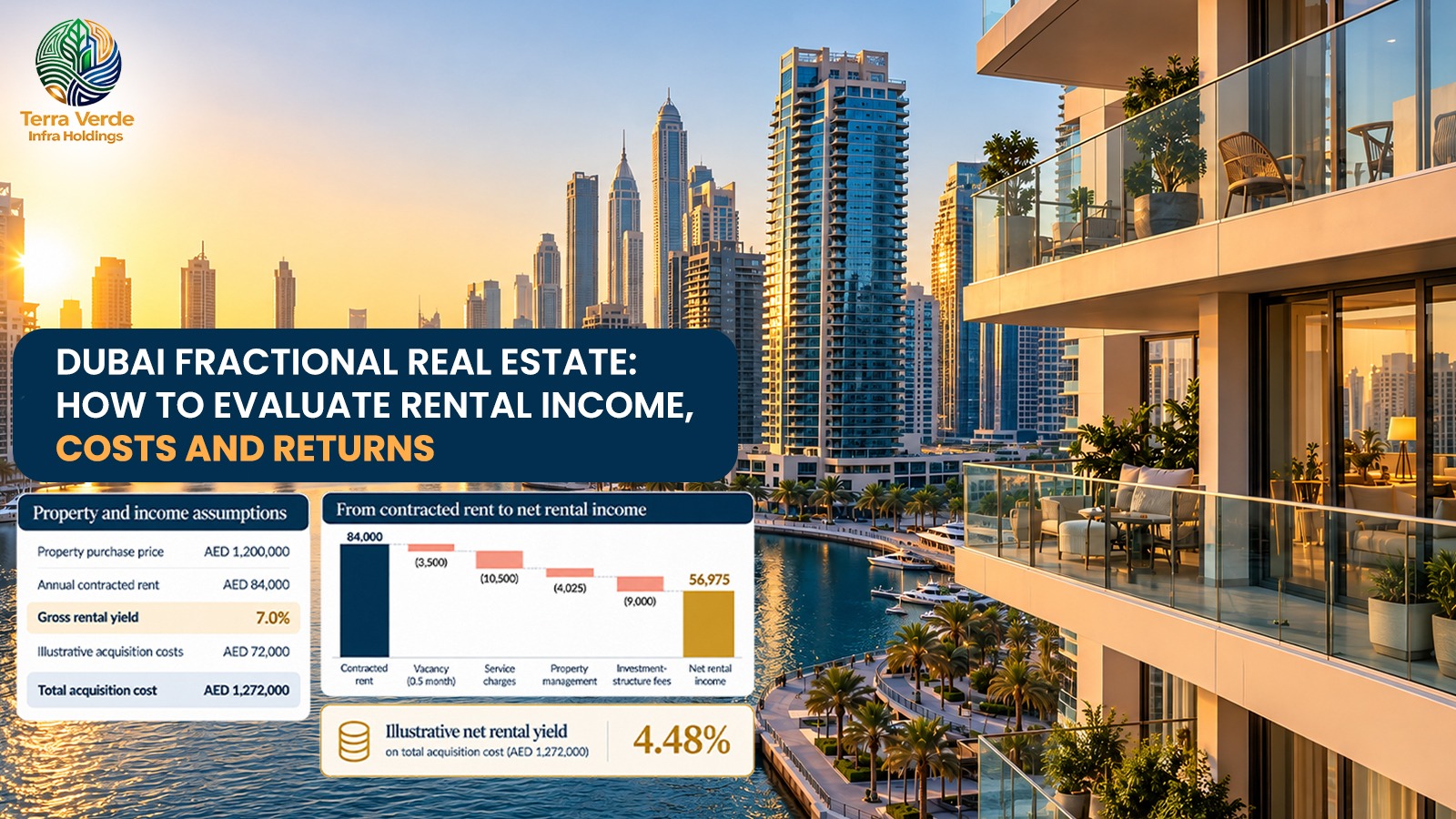
A property may be presented with an attractive rental yield, but the assumptions behind that figure deserve as much attention as the percentage itself.
Ask:
For an occupied property, current rental documentation can help establish the contracted income. For an unoccupied or off-plan property, projections require different assumptions and may carry additional uncertainty.
Rental income and capital appreciation should also be assessed separately. A projected valuation increase is not realised profit, and a rental yield does not establish the price at which an asset can eventually be sold.
The most useful presentation is one that makes assumptions visible and allows investors to understand how the numbers were calculated.
Part 3: Understand the investment economics and operations
7. Request a complete fee schedule
Fees can materially affect the income an investor receives and the amount recovered when an investment is sold.
Depending on the offering, fees may include:
Request one written schedule showing how each fee is calculated, when it is charged, who receives it, and whether it can change.
Clarify whether fees are fixed, percentage-based, or conditional on a particular event.
Also establish whether acquisition costs are included in the quoted investment amount or charged separately.
A clear comparison should use the same basis for all opportunities. A property advertised at a gross yield of 7%, for example, cannot be fairly compared with another investment showing a net yield after fees.
The purpose is not to assume that fees are inherently problematic. It is to understand their effect on the investment.
8. Understand governance and decision-making
In a fractional arrangement, you may not make every decision about the property independently.
The governing documents should explain who can make decisions and which matters require investor consent, voting, or another approval process.
Ask who is responsible for:
If investors have voting rights, establish how votes are counted, what threshold is required, and how decisions bind investors.
If the platform or manager retains decision-making authority, understand the scope of that authority and the protections or remedies available to investors.
Clear governance helps investors understand how their interests will be managed after the initial investment.
9. Check reporting and financial transparency
For an investor who is not physically present in Dubai, consistent reporting is an important part of monitoring an investment.
Before committing, ask what information you will receive and how frequently.
Relevant reporting may include:
Ask whether reporting commitments are documented and who prepares the reports.
Where audited financial statements are available, understand which entity they cover and what they establish. An audit of a company does not automatically establish the quality, profitability, or suitability of every investment it offers.
The objective is to know how the investment will be monitored and how you will obtain information about its performance.
10. Understand where funds and property interests are held
Before transferring money, establish the payment arrangements and the relationship between the recipient and the investment.
Ask:
Do not assume that funds are protected simply because a platform uses an escrow account, a regulated service provider, or a separate company. The applicable protections depend on the actual arrangement and relevant legal requirements.
Verify payment instructions independently before transferring funds, especially if account details change during a transaction.
If you cannot establish who receives your money, why that entity receives it, and what happens if the transaction does not proceed as expected, pause and seek clarification.
11. Understand the exit and risk disclosures
Before investing, establish how you may recover your capital and what risks could affect the outcome.
Ask whether the investment has a defined holding period, whether transfers are permitted, whether a secondary market exists, and what restrictions or costs apply.
If a secondary market is offered, distinguish the ability to list an interest for sale from the ability to find a buyer at a particular price or within a particular timeframe.
Also establish what happens when the underlying property is sold, who can initiate that sale, how proceeds are allocated, and which fees or liabilities may be deducted.
Finally, read the risk disclosures and investment terms carefully. They should explain the material risks, assumptions, restrictions, and potential conflicts relevant to the specific arrangement.
Be particularly careful with claims such as:
Ask for the evidence and contractual terms behind material claims. Obtain independent legal, financial, or tax advice where appropriate.
A transparent investment process does not eliminate risk. It helps you understand the risks you are accepting.
Your fractional real estate due-diligence checklist
Use the following checklist when comparing platforms or reviewing a specific Dubai residential property opportunity.
| Area | What you should establish |
|---|---|
| Corporate identity | Legal entities, registration details, issuing authorities, and responsibilities |
| Regulatory framework | Applicable permissions, their scope, and independent verification |
| People and providers | Who is accountable for acquisition, management, reporting, and administration |
| Legal ownership | The exact interest acquired and the documents establishing your rights |
| Property | Ownership evidence, relevant encumbrances, tenancy information, and valuation |
| Income assumptions | Evidence for rent, vacancy assumptions, and the basis of the yield calculation |
| Fees | Complete entry, ongoing, administrative, and exit costs |
| Governance | Decision-making authority, voting rights, and conflict-of-interest arrangements |
| Reporting | Income, expenses, valuations, financial statements, and reporting frequency |
| Funds and custody | Payment recipient, account arrangements, applicable safeguards, and continuity provisions |
| Exit and risks | Holding period, transfer restrictions, sale process, potential costs, and risk disclosures |
For each item, record three things: the answer provided, the supporting document, and whether you have independently verified it.
This turns due diligence from a collection of questions into a structured decision-making process.
How to apply these checks when evaluating a Terra Verde opportunity
At Terra Verde Infra Holdings, the purpose of investor education should be to help prospective investors understand the opportunity they are considering before deciding whether to proceed.
If you are evaluating a specific Terra Verde Dubai residential fractional investment, request the relevant offering materials and establish the following for that opportunity:
The answers should be specific to the relevant offering and supported by appropriate documentation. They should not be inferred from general marketing materials or assumed to apply identically across different properties or structures.
Terra Verde's investor communications should make it straightforward for prospective investors to request and review the applicable information.
The aim is not to ask investors to rely on a brand promise. It is to help them understand the documented opportunity and make an informed decision.
Frequently Asked Questions
Start by verifying the relevant company's legal identity and the permissions applicable to its activities. Then examine the investment structure, property documentation, investor rights, fees, reporting, custody arrangements, and exit provisions. Confirm important details through official records and independent professional advice where needed. No single registration or document proves that an investment is risk-free or suitable for you.
Make your next investment decision an informed one
Dubai residential real estate offers investors a market worth understanding, and fractional ownership provides another structure to evaluate when considering property exposure.
The most productive starting point is not a promise of returns. It is a clear understanding of the asset, the legal arrangement, the costs, the investor's rights, and the available exit options.
Bring your questions. Examine the documents. Understand the terms.
The quality of an investment decision begins with the quality of the information behind it.
Important information: This article is for general educational purposes only and does not constitute investment, legal, or tax advice, or an offer to invest. Legal and regulatory requirements depend on the specific structure, activities, and applicable law and may change. Property values and rental income can fall as well as rise, and returns are not guaranteed. Verify the documentation and terms of any specific offering and seek independent professional advice where appropriate.