How Does Fractional Property Ownership Work in Dubai? A Practical Guide for Global Investors
Understand how fractional property ownership works in Dubai, how investors participate in residential real estate, potential income and appreciation, risks, due diligence, exits, and what to check before investing.
Fractional Property Ownership in Dubai: The Simple Idea
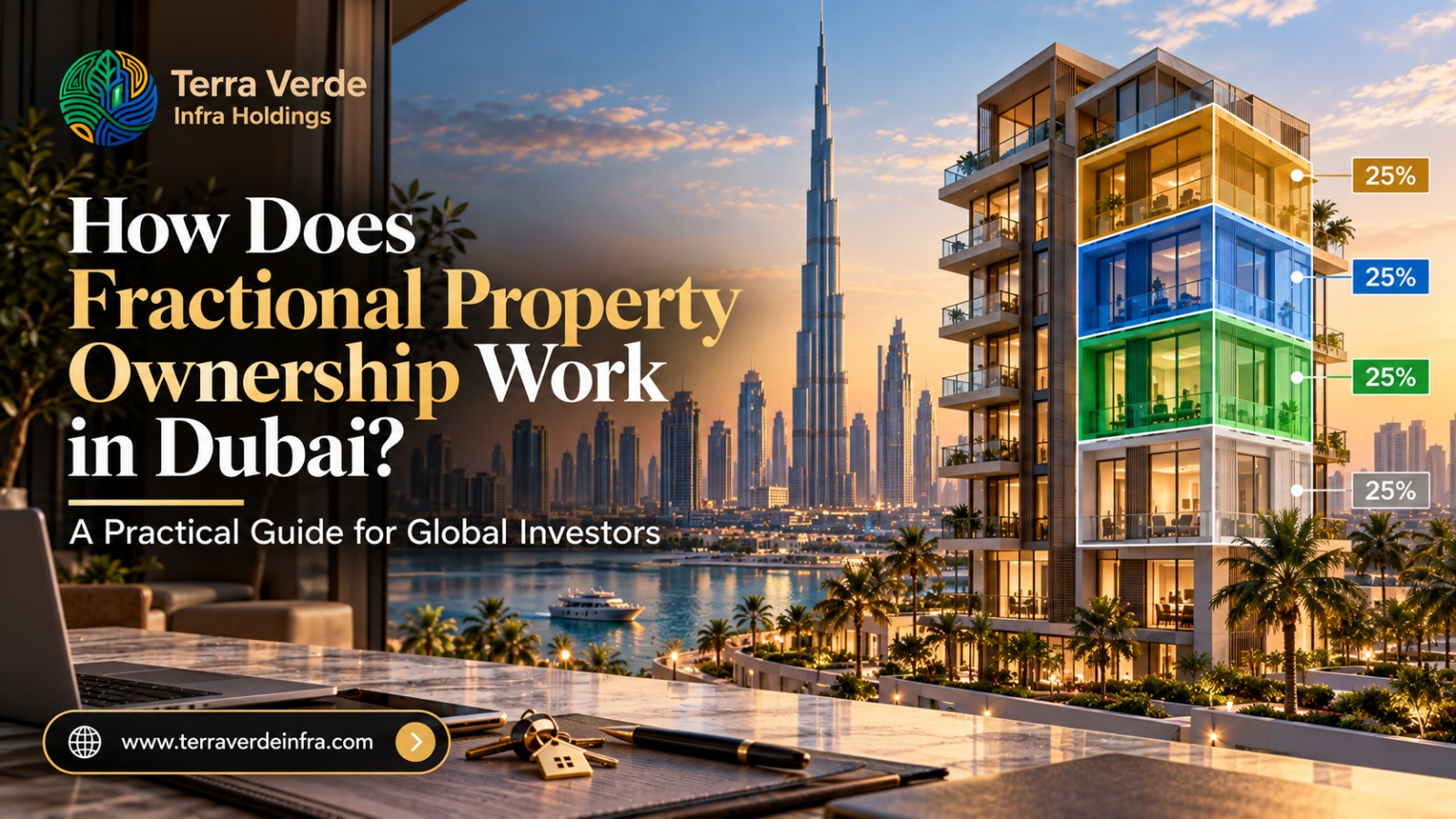
Buying a Dubai property outright can require substantial capital. Fractional property ownership in Dubai introduces a different way to participate in Dubai property investment: multiple investors can collectively participate in a property, with each investor's economic interest defined by the legal structure and investment documents.
The important point is not simply that the property is divided into smaller pieces. It is that the ownership, investor rights, income distribution, expenses, governance and exit process must be clearly structured.
For an investor considering Dubai residential real estate or a Dubai fractional property investment, the first question should therefore be less "How small can my investment be?" and more "What exactly am I investing in, what rights do I receive, and how does the structure work from purchase to exit?"
What Is Fractional Property Ownership?
Fractional property ownership, also referred to as fractional ownership real estate, is a structure in which more than one investor participates in the ownership or economic interest of a property. The exact legal form can vary. In some structures, investors may hold interests through an SPV or another legal vehicle that owns the underlying property. In others, the ownership arrangement may be documented differently.
This distinction matters. A sophisticated investor should never assume that buying a "fraction" of a fractional residential property automatically means holding a directly registered slice of a title deed. The offering documents should explain the legal entity, ownership rights, voting or decision rights, distribution mechanism, fees and exit provisions.
How Does Fractional Property Ownership Work in Dubai?
While structures vary, the investor journey in fractional real estate in Dubai generally follows these stages:
Why Dubai Residential Real Estate?
Dubai is not simply a backdrop for a fractional-investment story. It is a major international real estate market with a large and active rental ecosystem. Dubai Land Department reported that registered tenancy contracts in 2025 increased 6% in volume and 17% in value versus 2024, reaching 1.38 million contracts with a total value of AED 126.4 billion. DLD also reported AED 32.2 billion in rental-contract value during Q1 2026.
For an investor considering Dubai property investment, these figures do not guarantee the performance of any individual property. They do, however, illustrate why rental demand and property-level fundamentals deserve serious attention when evaluating a Dubai residential opportunity.
That is where a well-structured Dubai fractional property investment model can become interesting: it can combine participation in a specific residential asset with professional management and a lower capital requirement than purchasing the entire property outright.
How Can Fractional Real Estate Generate Returns?
At a high level, investors in fractional real estate in Dubai typically look at two potential components: income generated by the property and changes in the property's value over time.
Rental income: If the fractional residential property is rented, rental receipts can contribute to investor distributions after applicable operating costs, management charges and other expenses. Actual distributions depend on occupancy, rent achieved, expenses and the legal/economic structure.
Capital appreciation: If the underlying property increases in value and is eventually sold, investors may participate in the resulting gain according to the structure and their economic interest. Property values can also fall, so appreciation should never be treated as automatic.
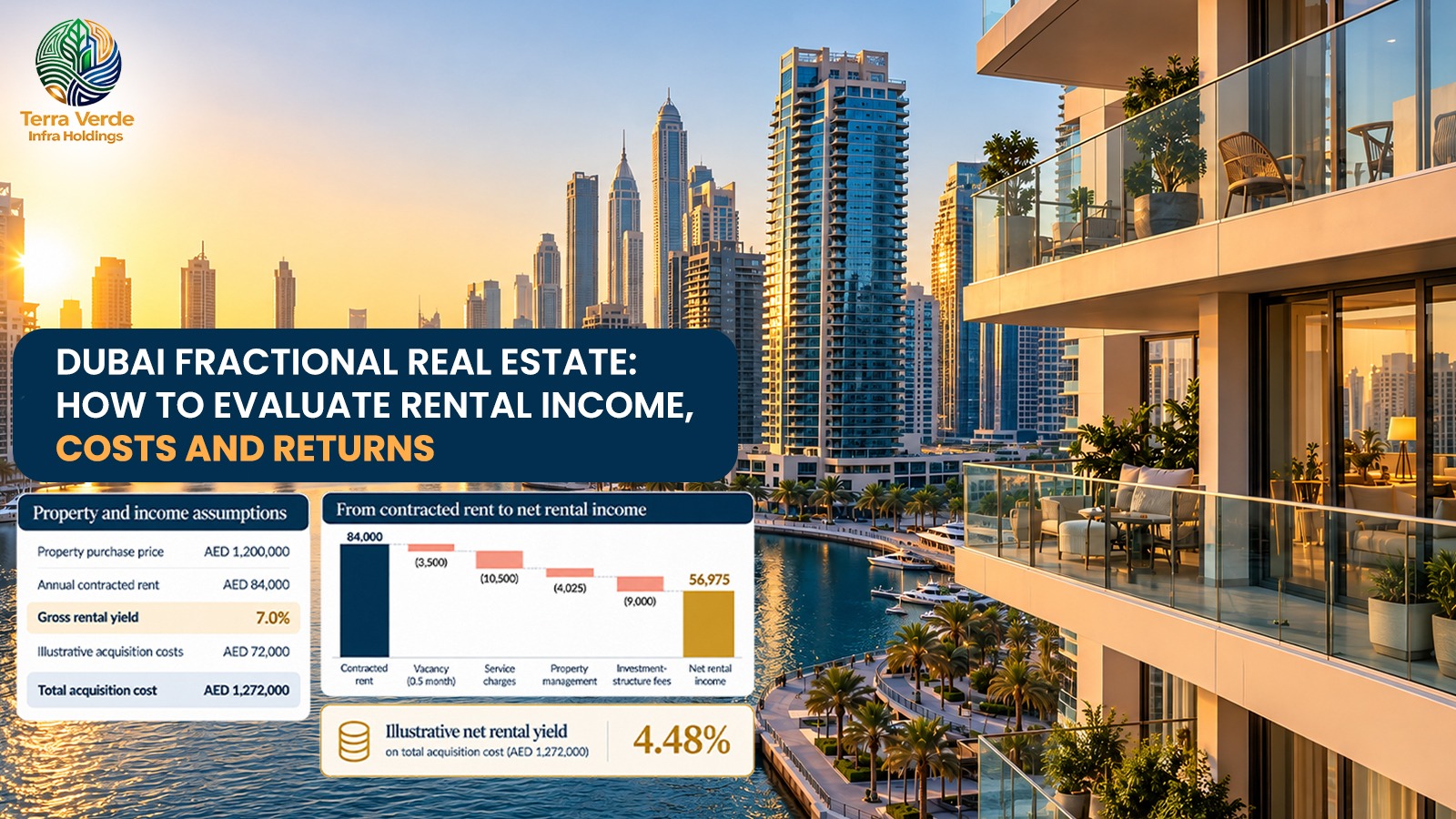
An investor should therefore evaluate net economics rather than headline yield alone. Ask what costs are deducted, whether projections are gross or net, how vacancies are treated, who bears major repairs, and what assumptions underpin the expected outcome.
The Advantages Investors Often Look For
What Fractional Property Ownership Does NOT Remove
Fractional ownership changes the way capital is deployed; it does not remove real-estate risk. This is an important part of an educational article and should remain visible rather than being buried at the end.
What Should You Check Before a Dubai Fractional Property Investment?
Fractional Property Ownership vs REITs: Are They the Same?
No. Fractional ownership real estate and REITs are different investment structures and should not be presented as interchangeable.
| Consideration | Fractional property structure | REIT |
|---|---|---|
| Underlying exposure | Typically tied to a defined property or defined pool/structure | Exposure through the REIT's portfolio |
| Investor choice | May be able to select a specific property, depending on the platform/model | Portfolio decisions are made by the REIT manager |
| Liquidity | Depends on the structure and available transfer/exit mechanism | Listed REIT units can generally be traded on the relevant exchange during market hours |
| Diversification | Often more concentrated at the property level | Generally diversified across assets within the REIT |
| Legal/regulatory framework | Depends on the specific structure and jurisdiction | Subject to the applicable REIT regulatory framework |
A Better Way to Think About Fractional Ownership
The most useful mental model is not "own more real estate for less money." It is "gain structured access to a specific real-estate opportunity with clearly defined rights, responsibilities, costs and exit conditions."
That shift in thinking is important for global investors exploring Dubai property investment. The quality of the underlying property matters. So does the legal structure. So does the operator. And so does the transparency of the investment process.
Why Transparency Matters
Dubai has a formal real-estate regulatory ecosystem, and Dubai Land Department publishes information and services covering areas such as project registration, title-related services and real-estate development escrow mechanisms. For off-plan development projects, DLD states that project escrow accounts are used for amounts collected from purchasers and financiers, with the system intended to regulate development and help protect purchasers.
However, investors should not assume that the existence of Dubai's broader regulatory framework automatically validates every fractional real estate offering. The specific investment structure still needs to be examined on its own documents and facts.
Is Fractional Property Ownership Right for Every Investor?
No single real-estate structure is suitable for everyone. Fractional residential property ownership may appeal to investors who want exposure to a defined property with a lower capital allocation than full ownership and who are comfortable with the relevant holding period, liquidity constraints and property-level risk.
The right starting point is therefore education and due diligence—not a promise of returns.
Frequently Asked Questions
It is a structure that allows multiple investors to participate in the ownership or economic interest of a property, with rights and economics determined by the legal and investment documents.
The Terra Verde Perspective
Terra Verde Infra Holdings focuses on premium Dubai residential fractional real estate, with an education-first approach to helping investors understand the structure before considering an opportunity.
The purpose is not to reduce a property investment to a single return number. It is to make the investment architecture easier to understand: the property, the ownership structure, the management process, the economics, the risks and the potential exit.
If you are exploring fractional property ownership in Dubai, the next step should be to understand how a specific opportunity is structured rather than relying on a generic definition of fractional ownership.
Conclusion
Fractional property ownership in Dubai can make participation in selected Dubai residential real estate more accessible by allowing investors to allocate capital without purchasing an entire property alone. But accessibility should never be confused with simplicity or certainty.
A strong Dubai fractional property investment case rests on more than a property and a projected return. Investors should understand the legal structure, underlying asset, management, fees, income assumptions, reporting, liquidity and exit mechanics before committing capital.
For global investors evaluating Dubai residential real estate, that is the real value of education-first investing: knowing exactly what you are buying, how it is structured and what questions to ask before you decide.
Sources & Regulatory References
Disclaimer: This article is for general educational and informational purposes only. It does not constitute financial, legal, tax or investment advice, and it does not guarantee any return or outcome. Specific investment structures, eligibility, fees, taxation and regulatory requirements should be reviewed with appropriate professional advisers before investing.