
Fractional Ownership vs Full Property in Dubai: What's the Real Difference?
Compare fractional property ownership UAE with full property purchase in Dubai — costs, returns, risks and which suits Indian investors.
Full property ownership gives you control over an entire asset. Fractional ownership gives you access to a defined share of a property investment. But the real difference goes deeper than the amount of money you invest.
For an investor considering Dubai residential real estate, the more important questions are:
That distinction matters even more as Dubai's residential market moves from the rapid growth phase of recent years toward a more nuanced, selective environment.
CBRE reported that Dubai residential transactions remained elevated in Q1 2026, with more than 45,000 residential transactions worth AED 137 billion, while price and rental growth began moderating. Its Q2 review subsequently noted softer demand, lower transaction activity during the quarter, and new supply helping to ease pricing pressure.
The lesson isn't that investors should step away from Dubai. It is that how you enter the market matters.
What Is Full Property Ownership?
With a traditional property purchase, an investor acquires an entire residential property, subject to the legal title and ownership structure applicable to that transaction.
The investor generally has greater control over:
But that control comes with a larger capital requirement and greater concentration. If one investor owns one apartment worth $300,000, the entire investment is concentrated in that single asset — carrying full exposure to vacancy, property-specific expenses, maintenance, market movements, tenant issues, selling costs and the timing of the eventual exit.
Full ownership provides greater control — but also greater concentration of capital and responsibility.
What Is Fractional Real Estate Ownership?
Fractional real estate allows multiple investors to participate in a property investment through a defined ownership or investment structure. Instead of one investor providing the entire capital requirement, the investment is divided among participating investors according to the structure of the offering.
An important distinction is often missed:
"Fractional ownership" does not describe one universal legal structure.
Depending on the arrangement, an investor may hold direct co-ownership, an interest through an SPV, a beneficial interest, or another legally defined investment interest.
So the first question should not simply be "How much does one fraction cost?" It should be "What exactly does my investment legally represent?" — a question that should be answered through the transaction documents before an investor commits capital.
The Key Differences at a Glance
| Factor | Full Property Ownership | Fractional Ownership |
|---|---|---|
| Initial capital | Usually substantially higher | Can provide access with a smaller allocation |
| Asset exposure | Entire property | Defined share/exposure according to structure |
| Control | Greater direct control | Usually shared or structure-dependent |
| Diversification | Requires more capital to diversify | Smaller allocations may make diversification more accessible |
| Management | Owner carries greater responsibility unless delegated | May be professionally managed depending on structure |
| Personal use | May be available subject to property rules | Not automatically available; depends on structure |
| Income | Owner receives income attributable to entire asset | Income distribution depends on the investment structure |
| Exit | Owner controls sale decision, subject to market conditions | Exit mechanism depends on documents, structure and buyer demand |
| Liquidity | Property itself is not instantly liquid | A fraction is not automatically liquid either |
| Due diligence | Property + transaction | Property + transaction + structure + manager/platform |
The table highlights something important: fractional does not mean "simpler in every respect." It changes the way capital, ownership, management and risk are organised.
1. Capital Requirement: How Much Do You Actually Need?
Buying an entire Dubai apartment can require substantial capital — the purchase price plus transaction costs, registration-related charges, professional fees, financing costs where applicable, furnishing, maintenance and ongoing management.
Fractional investing reduces the capital required to participate in a specific property. That shifts the question from "Can I afford this entire property?" to "How much capital do I want allocated to this particular property?" — relevant for investors who want Dubai exposure without concentrating a large share of capital in one apartment.
A smaller entry amount does not mean lower investment risk. It simply changes the amount of capital exposed.
2. Diversification: One Property or Multiple Exposures?
Consider two hypothetical investors. Investor A allocates $300,000 to one apartment. Investor B allocates smaller amounts across several qualifying property investments.
Investor A has greater control over one property. Investor B may have greater diversification across assets, depending on the opportunities available and the structures used.
Diversification can reduce concentration at the portfolio level — it does not eliminate real-estate risk. Different properties remain exposed to market conditions, location, developer performance, rental demand, supply, management quality, financing conditions and exit demand.
The objective is not simply to own more properties. It is to understand what exposure each investment creates.
3. Control: Where Full Ownership Differs Most
Full ownership generally gives an investor greater decision-making authority over the asset, subject to applicable laws, title conditions, building rules and contractual arrangements.
Fractional investment involves shared economic exposure or shared ownership rights according to its specific legal structure. An individual investor typically does not independently decide when the property is sold, which tenant is selected, how the property is managed, whether it is renovated, or how certain expenses are handled.
This isn't necessarily a disadvantage — it's a different investment model. An investor who values maximum control may prefer direct ownership. An investor who values access, delegation and portfolio allocation may find a professionally structured fractional model more relevant. The key is understanding which rights you are actually receiving.
4. Management: Who Actually Handles the Property?
Owning a property does not necessarily mean personally managing it. A full-property owner can appoint a property manager; some fractional structures incorporate professional management by default.
But investors should never assume management is automatically included. Before investing, check:
A professionally managed investment can reduce operational involvement — but it doesn't remove the need for investor due diligence.
5. Income: Look Beyond the Headline Yield
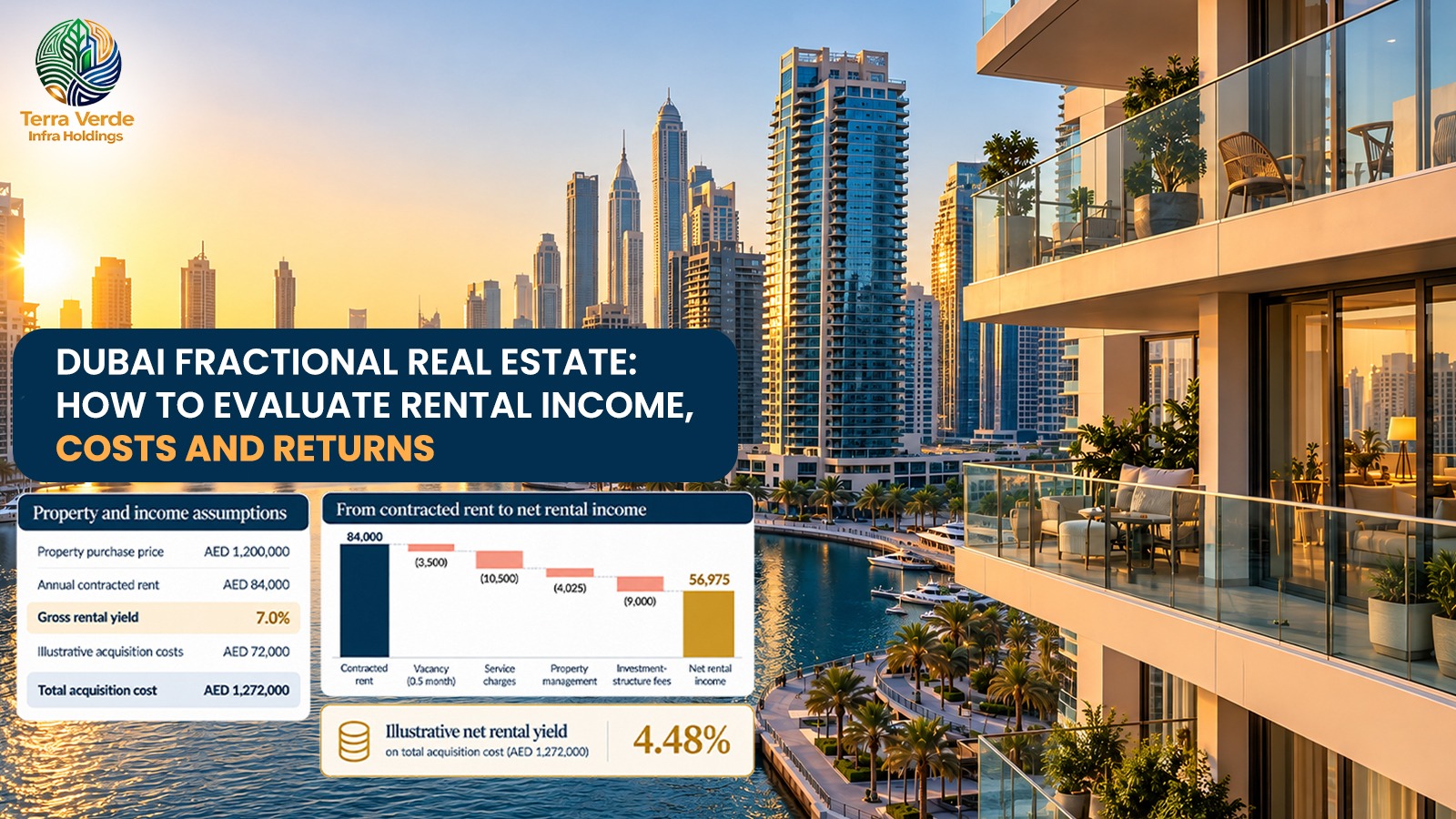
One of the most important questions in any real estate investment is: what is the actual net income after costs? A headline rental yield rarely tells the complete story. Investors should distinguish between:
Two properties showing the same headline yield can produce very different investor outcomes. Projected yields should never be treated as guaranteed income.
6. Liquidity: Neither Model Should Be Confused With a Stock
This is one of the most important misconceptions to address. A fractional investment is not automatically liquid simply because the investment amount is smaller. A full property is not instantly liquid just because the owner controls the asset.
For a full property, the investor generally needs a buyer willing to purchase the property. For a fractional investment, the exit mechanism may depend on transfer provisions, platform rules, other investors, the existence of a secondary buyer, valuation, transaction costs, lock-in periods, manager or SPV procedures, and market demand.
Fractional ≠ instant liquidity. Ask exactly what the documented exit process is before investing.
7. Personal Use: Ownership and Investment Access Are Not the Same Thing
A full-property owner may have the ability to use the property personally, subject to applicable property rules and any tenancy arrangements. A fractional investment should not automatically be assumed to provide the same right — some structures are designed primarily around economic participation rather than personal occupancy.
If personal use matters to you, ask specifically: "Do my ownership or investment rights include any occupancy or usage rights?" If the answer is not clearly documented, don't assume it.
8. Costs: Compare the Complete Investment, Not Just the Entry Price
Full-property ownership can involve acquisition and registration expenses, legal or professional fees, financing costs where applicable, property management, maintenance, service charges and eventual selling costs.
Fractional ownership may distribute certain expenses across multiple investors — but that does not automatically make it cheaper. Depending on the structure, investors may still encounter management fees, administration fees, acquisition costs, property-level expenses, currency conversion costs, or transfer and exit charges.
The right comparison isn't "which has the lower purchase price." It's "what is my total cost of ownership, and what do I actually receive for those costs?"
9. Risk: A Different Structure, Not No Risk
Fractional ownership should never be presented as risk-free. Layers of risk worth considering include:
The goal isn't to find an investment with "no risk." It's to understand where the risks sit and how they're being managed.
10. What Indian Investors Should Verify
Indian residents can use permitted remittance routes for eligible overseas investments. The Reserve Bank of India currently allows resident individuals to remit up to US$250,000 per financial year under the Liberalised Remittance Scheme (LRS), subject to applicable rules and conditions, and RBI guidance recognises permitted remittances for the acquisition of immovable property outside India.
Investors should not assume every fractional real-estate structure is automatically treated the same way — the legal structure of the specific investment matters. Indian investors should verify:
A qualified tax professional or authorised dealer bank should always be consulted for individual circumstances. Rules can change.
11. What About Dubai Taxes?
One of Dubai's attractions for international investors is its tax environment — the UAE does not levy personal income tax on individuals. This should not be interpreted to mean an Indian resident's overseas real-estate investment is automatically "tax-free."
The investor's home-country tax and reporting obligations remain relevant. The correct question isn't "does Dubai have income tax?" It's "what is the tax treatment in both jurisdictions for my specific investment structure?"
The Hidden Question: What Are You Actually Buying?
This may be the most important part of the entire comparison. Before investing in fractional real estate, understand the complete structure.
Ownership
Financials
Property
Management
Exit
Risk
These questions aren't designed to make fractional investing sound complicated. They're designed to make investors better informed.
So, Which Model Is Right for You?
There isn't one universal answer. The decision depends on what the investor values.
Full property ownership may suit an investor who prioritises:
Fractional investment may suit an investor who is looking for:
The investment model should follow the investor's objective — not the other way around.
What Dubai Investors Should Focus On in 2026
Dubai's residential market has continued to show substantial transaction activity, while the pace of price and rental growth has begun to moderate from the exceptionally strong levels seen previously. CBRE's Q1 2026 report recorded more than 45,000 residential transactions worth AED 137 billion, while its Q2 report described a market where softer demand and incoming supply were beginning to ease pricing pressure.
For investors, this creates a useful shift in mindset — from "Is Dubai real estate going up?" to "Which property, which structure, at what valuation, with what income assumptions, fees, ownership rights and exit mechanism?" That is the foundation of informed real estate investing.
The Terra Verde Perspective: Think in Terms of Wealth Architecture
At Terra Verde, we believe the conversation around Dubai real estate should go beyond simply asking "How much property can I buy?" A more useful question is: "How should this property exposure fit into my broader wealth architecture?"
That means examining:
- Capital
- Asset
- Structure
- Income
- Risk
- Diversification
- Exit
Terra Verde's fractional real estate approach is designed around giving investors access to Dubai residential property opportunities through a structured investment model, with current participation starting from USD 2,000, subject to the specific offering and applicable terms.
The purpose is not to suggest that fractional ownership replaces full property ownership. It is to create another way for investors to consider Dubai residential real estate as part of a broader investment strategy.
Understand what you own before deciding how much you want to own.
A Simple Investor Checklist
Before investing in any fractional Dubai property opportunity, ask these ten questions:
If a platform can't answer these questions clearly, that's a reason to pause.
Frequently Asked Questions
No. The legal and economic rights depend on the specific structure. Investors should establish exactly what interest they are acquiring before investing.
Final Takeaway
Full ownership and fractional ownership solve different investment problems. Full ownership prioritises control and complete exposure to an individual property. Fractional ownership can provide a structured way to participate in a property investment with a smaller capital allocation.
Neither should be judged purely by the entry price or projected yield. The more important questions are: What do I own? How is my capital being used? What does the property actually earn after costs? What risks am I taking? And how do I exit?
That is where real estate investing becomes wealth architecture — not simply property buying.
Investment involves risk. Past or projected property performance does not guarantee future results. Specific ownership rights, fees, income distributions, transfer restrictions and exit mechanisms vary by offering and should be reviewed in the relevant documentation. This article is for educational purposes and does not constitute investment, legal or tax advice.