
Dubai Fractional Real Estate: How to Evaluate Rental Income, Costs and Returns
Learn how to evaluate Dubai fractional real estate, calculate net rental yield, assess fees and ownership structures, and understand exit options before investing.
What if evaluating a Dubai property investment started with a better question—not simply how much rent it could generate, but how much income might remain after costs, what you would legally own, and how you could eventually exit?
For professionals, business owners, and globally minded investors, Dubai residential real estate can be an opportunity to explore international property exposure. Yet buying an entire apartment is not the only structure worth understanding.
Fractional ownership provides a way to participate in a property investment through a defined ownership or investment structure, subject to the legal arrangements of the specific offering.
The key is knowing how to evaluate the opportunity before committing capital.
Whether you are comparing a full property purchase with fractional ownership or assessing two fractional opportunities, five factors deserve particular attention: rental income, property expenses, investment structure, property valuation, and exit arrangements.
1. Start with the income the property can realistically generate
A property's advertised rental yield is a starting point, not a complete investment analysis.
Gross rental yield is generally calculated by dividing annual rental income by the property's purchase price and multiplying by 100.
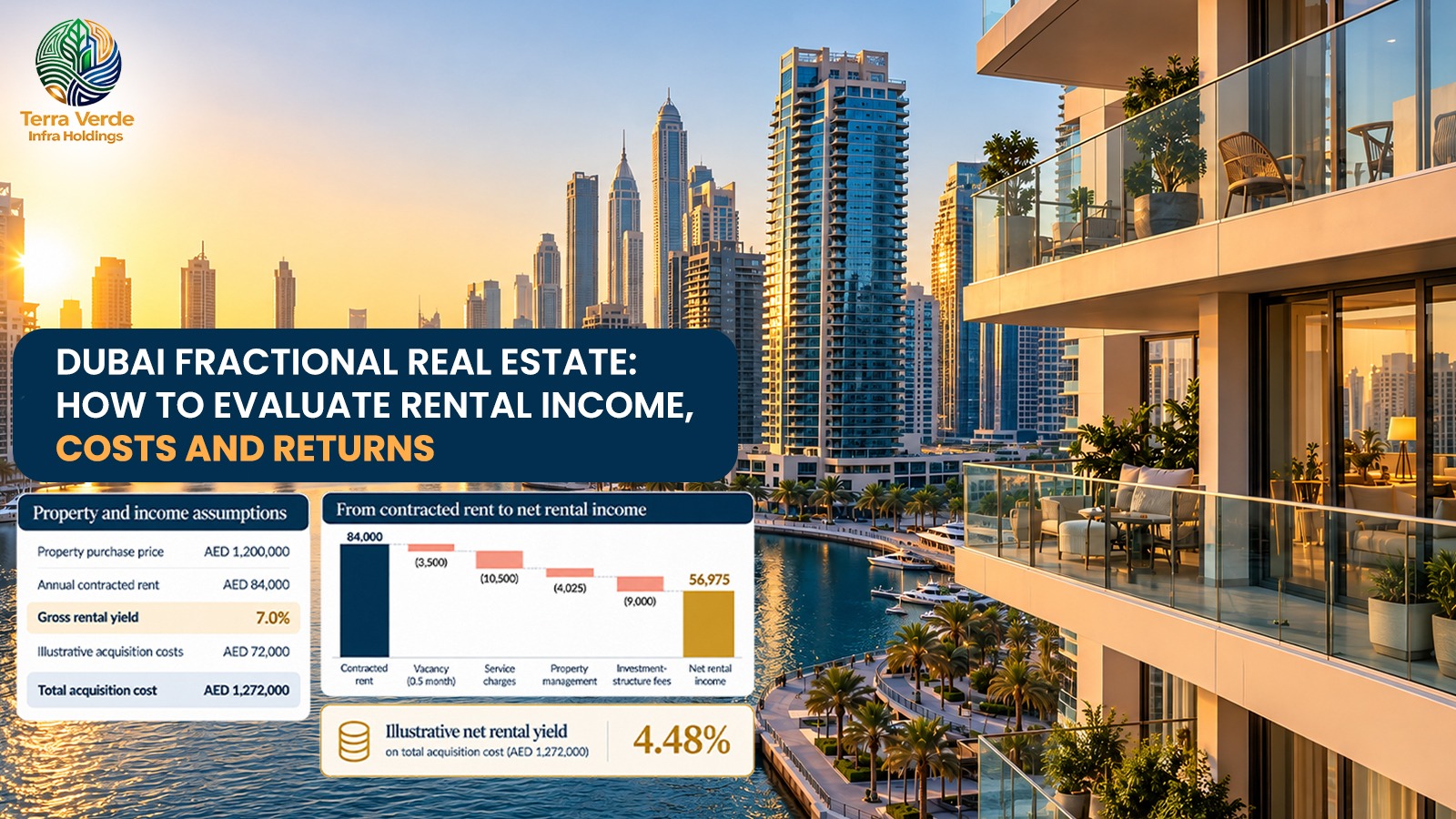
For example, an apartment priced at AED 1,200,000 with annual rent of AED 84,000 has a gross rental yield of 7%.
Gross rental yield = Annual rent ÷ Property purchase price × 100
However, gross yield does not account for vacancy, service charges, management fees, or the costs associated with the investment structure.
Before relying on a rental projection, ask:
The objective is not to find the most attractive headline figure. It is to understand the assumptions behind it.
2. Understand the costs that affect net rental income
Two apartments with similar purchase prices and rental income can produce different financial outcomes because their operating costs differ.
Dubai residential properties may incur service charges for common-area maintenance, security, lifts, amenities, and other shared facilities. The amount depends on the specific development and applicable charges.
Investors can consult the Dubai Land Department's official Service Charge Index to investigate approved service charges for eligible jointly owned properties.
Official resource: Dubai Land Department — Service Charge Index
Other expenses may include property management, maintenance, insurance where applicable, vacancy-related costs, and utilities or cooling charges depending on the arrangements.
Before comparing properties, establish which expenses are included in the projected net income and which remain payable by the investor or investment vehicle.
A transparent comparison should show the calculation, not just the final percentage.
3. Examine the fractional investment structure
Fractional ownership is not defined by the entry amount alone. The legal structure determines what an investor actually acquires and which rights accompany that interest.
Depending on the arrangement, an investment may involve shares or interests in a company or special purpose vehicle (SPV), a registered property interest, or another legally documented structure.
These arrangements are not interchangeable.
Before investing, establish:
Also request a written schedule of applicable fees.
This may include acquisition or sourcing fees, ongoing asset management fees, property management charges, SPV administration, accounting, audit expenses, and transfer or exit fees, depending on the offering.
Ask when each fee is charged, how it is calculated, and whether it is deducted before income is distributed.
The essential principle: understand the legal interest, the decision-making process, and the complete fee structure before evaluating the projected income.
4. Evaluate the property's value separately from its rental income
Rental income and capital appreciation are two different components of a property's potential investment outcome.
Rental income depends on leasing performance and expenses. Capital appreciation depends on the property's market value and is generally realised only when the asset or the relevant investment interest is sold.
Neither is guaranteed.
For a full property purchase, Dubai Land Department registration fees and other transaction expenses contribute to the total acquisition cost. The standard property sale registration fee is generally 4% of the sale value, subject to the applicable rules and transaction arrangements.
For a fractional investment, investors should check how acquisition costs are allocated, whether these costs are included in the stated investment price, and whether any additional charges apply.
It is equally important to understand how the property will be valued during the holding period.
Ask who determines the valuation, how frequently it is updated, and whether it is based on an independent assessment, comparable transactions, or another methodology.
A valuation estimate is not the same as a realised sale price.
5. Understand the exit before you enter
An investment may have an attractive income profile and still be unsuitable for someone who needs immediate access to their capital.
Fractional ownership does not automatically provide liquidity.
Depending on the legal structure and offering terms, an investor may face a minimum holding period, restrictions on transferring their interest, limited resale opportunities, or a process requiring approvals.
Before committing, ask:
The answers should be documented in the offering materials and governing agreements.
Understanding the exit is part of evaluating the investment—not a question to postpone until you want to sell.
6. Consider currency, tax and your personal investment objectives
For Indian residents evaluating overseas property investments, the property's performance is only one part of the overall financial picture.
These considerations should form part of the decision process alongside rental income, expenses, and exit terms.
7. A worked example: Why gross yield and net yield differ
Consider a hypothetical residential apartment with the following assumptions:
| Item | Illustrative amount |
|---|---|
| Property purchase price | AED 1,200,000 |
| Annual contracted rent | AED 84,000 |
| Gross rental yield | 7.0% |
| Illustrative acquisition costs | AED 72,000 |
| Total acquisition cost | AED 1,272,000 |
Now assume the property experiences half a month of vacancy, incurs annual service charges of AED 10,500, property management fees of AED 4,025, and annual investment-structure fees of AED 9,000.
The resulting illustrative calculation is:
| Calculation | Annual amount |
|---|---|
| Contracted rent | AED 84,000 |
| Less: vacancy | AED 3,500 |
| Less: service charges | AED 10,500 |
| Less: property management | AED 4,025 |
| Less: investment-structure fees | AED 9,000 |
| Illustrative net rental income | AED 56,975 |
The illustrative net rental yield on the total acquisition cost is approximately 4.48%, compared with the 7% gross yield.
This calculation assumes the stated fees are annual, that vacancy is not double-counted elsewhere, and that the listed expenses are the only deductions. It excludes any additional costs not specified above.
It is a simplified illustration, not a market benchmark, a forecast, a Terra Verde investment projection, or a representation of the income an investor will receive.
For fractional ownership, the calculation must also reflect the actual investment structure, the allocation of income and expenses, and any applicable investor-level deductions.
The lesson is straightforward: compare opportunities using consistent assumptions and a clearly defined net-income calculation.
8. A five-question framework for evaluating any fractional property
Before making a decision, ask:
If any of these questions remains unanswered, request clarification before proceeding.
A well-presented investment opportunity should make it possible to understand not only the potential benefits but also the assumptions, limitations, and risks.
Frequently Asked Questions
Fractional ownership is a way to participate in a property investment through a defined legal or investment structure without necessarily purchasing the entire property independently. The investor's rights depend on the specific structure and governing agreements.
The next step: Evaluate the structure, not just the headline yield
International residential property investment deserves a structured approach.
For investors exploring Dubai fractional real estate, the most useful starting point is a clear understanding of the property, its income assumptions, the associated costs, the legal investment structure, and the available exit arrangements.
An informed investment decision begins with the right questions.
Important information: This article is for general educational purposes only and does not constitute investment, legal, or tax advice, or an offer to invest. All examples are hypothetical. Rental income and property values can fall as well as rise, and returns are not guaranteed. Investment terms, legal rights, fees, eligibility, and exit arrangements must be verified against the relevant offering documents. Seek independent professional advice where appropriate.